


Increase conversions on Shopify using skin analysis tool


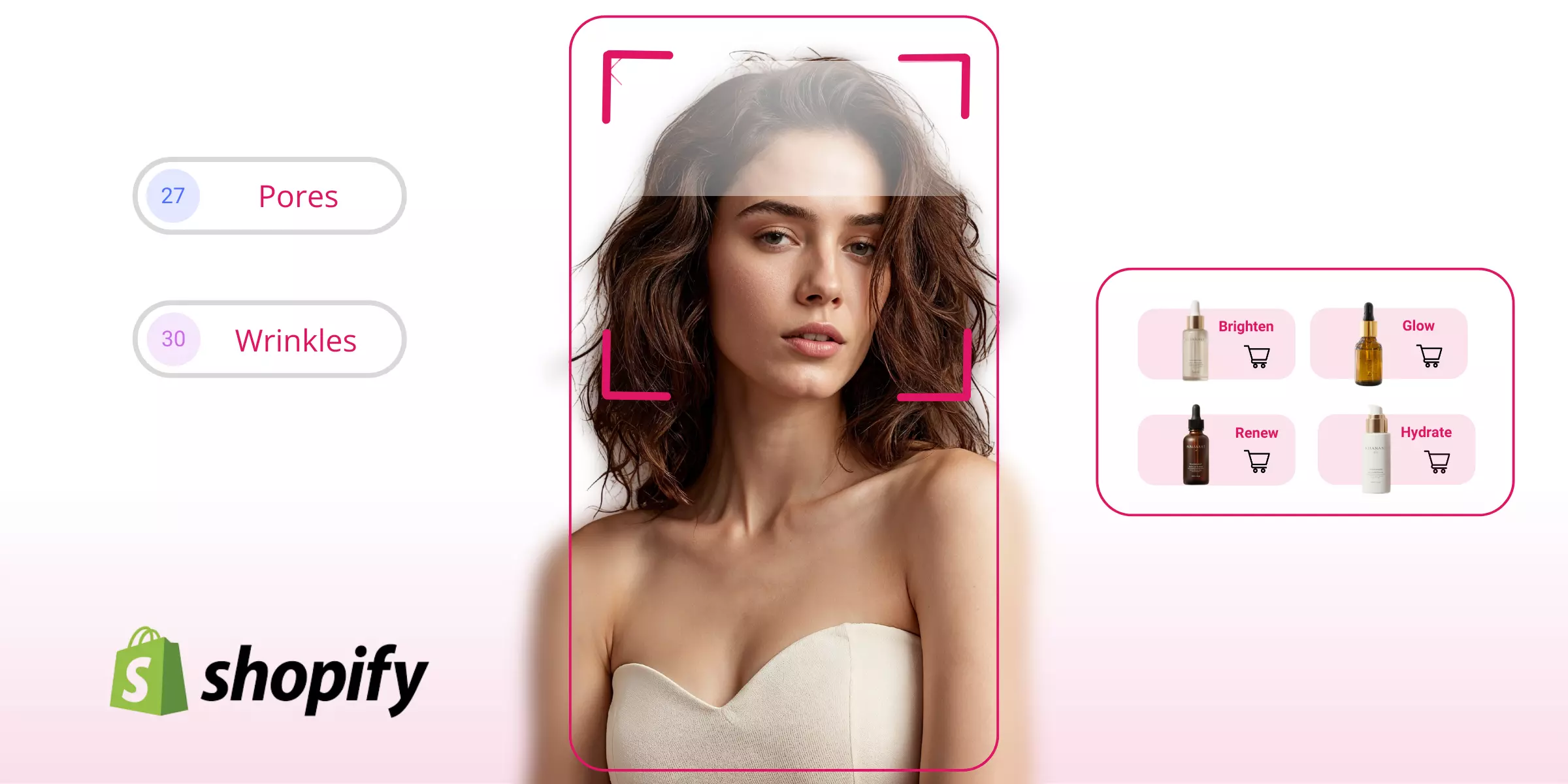
The skincare industry is a necessity of today’s world due to increasing pollution and environmental issues, which helps users to maintain their skin health and keep their skin healthy. According to the Grand View Research report, the global personalized skin care products market size was estimated at USD 26.20 billion in 2022 and is projected to reach USD 48.65 billion by 2030, growing at a CAGR of 8.0% from 2023 to 2030.
However, selecting the right skincare product is still a cumbersome task because it includes various factors, such as moisture level, dryness, acne, pores, and more, which can sometimes affect the conversion rate of e-commerce sellers due to users’ lack of knowledge and experience. To help users select the most suitable skincare products and improve brands’ conversions, skincare businesses can use the AI-based skin analysis tool on their e-commerce website or app, which will help them provide their customers with a personalized shopping experience.
Apart from that, most of the skincare brands and sellers use Shopify as their dedicated e-commerce platform due to its ease of use, robust features, scalability, security, and more, which makes it one of the best choices for e-commerce brands and sellers to launch their online store. In this blog, I will provide you with detailed information on how to use a skin analysis tool for Shopify successfully to help you understand how it will help you increase the conversion rate on a Shopify-based e-commerce website or app.

What is a skin analysis tool?
A skin analysis tool is an AI-based online tool that helps users understand their skin conditions by using advanced technologies, such as machine learning, computer vision, and multispectral imaging, while offering them personalized product recommendations with suitable ingredients. It provides users with a detailed skin analysis by digitally scanning their face for more than 10 skin issues, including hydration, wrinkles, pores, sun damage, and pigmentation, which will help them understand their skin issues and treat them with suitable ingredients.
It provides users with data-driven insights about their skin health, which will enable them to understand their skin issues and help them select the most suitable products depending on their skin conditions. Apart from that, it also helps businesses to improve their conversions and reduce product returns by helping their customers make more informed and confident purchase decisions while reducing their guesswork by providing them with detailed information.
Understanding the conversion challenges faced by skincare brands on e-commerce platforms
Skincare is a trending topic that shows its popularity among potential customers and audiences, which are targeted by skincare brands and businesses both online and offline. However, dealing with a virtual audience is a cumbersome task because some factors, such as trial experience, market saturation, brand transparency, and more, can affect their conversion rates.
In this section, I will provide you with detailed information on the challenges faced by e-commerce brands in the skincare industry and how it impacts their conversions.
1. Lack of in-person experience or trial
One of the biggest challenges that e-commerce skincare brands and sellers face is providing their customers with a trial or in-person-like shopping experience when they explore products virtually, according to their needs. It can also contribute to a higher cart abandonment rate because customers fail to understand the texture, scent, and color of the products, which can reduce conversion rates for the brand or online seller.
2. Intense competition and market saturation
The competition in the online skincare and beauty market is highly competitive and can create intense competition and market saturation for e-commerce platforms, which makes it a significant challenge for skincare brands to get recognized by their targeted audience.
Therefore, whenever customers see multiple options or brands for skincare products virtually, they get confused, and it also becomes difficult for brands to capture and retain customer attention and loyalty.
3. Building brand trust and transparency
With the increasing information about the ingredients present in the skincare products, the concern of customers for product ingredients, safety, and ethical practices is also increasing, which can lead to a lack of clarity or trust around ingredients, which can negatively impact conversion rates.
Apart from that, providing less information about the sourcing and manufacturing can create a lack of transparency among the users, which can also reduce their trust and loyalty towards the brands, leading to lower sales and decreasing conversion rates.
4. Fragmented customer experience
Another challenge that skincare brands face is maintaining their online presence across various platforms, including websites, marketplaces, and social media, which can make it difficult for them to create different strategies so that they can reach a wider audience through different platforms.
It can also cause difficulty for brands to provide a consistent experience for their customers to provide detailed information about product details, pricing, and return policies, which can develop inconsistency, confuse shoppers, and impact loyalty.
5. Creating compelling content
During virtual branding and marketing, brands do not provide their customers with physical interaction with the product, which makes them rely on excellent copywriting, high-quality images, and informative videos to convey product effectiveness.
Therefore, to provide their customers with better services and enhance their marketing strategies, they have to create compelling content for their website and ensure proper product usage education, which sometimes becomes a challenge for them.
6. Cart abandonment
Another challenge that skincare brands face during their online sales and branding is the cart abandonment rate, which can also lead to a reduction in conversions due to poor analytics, UX friction, and a complex checkout process, leading to low conversion rates.
Hence, various e-commerce skincare brands may cause issues in tracking consumer behavior and streamlining the checkout process, which will lead to lower conversion rates during online sales.
{{component="/internal/widgets"}}
Benefits of using a skin analysis tool for Shopify-based skincare brands
Using a skin analysis tool helps skincare businesses and brands in several ways, such as increasing engagement and conversions, reducing product returns and uncertainty, and providing customers with personalized experiences. Therefore, using a skin analysis tool for Shopify-based brands will help them to improve their online presence, build customer loyalty, and enhance their conversion rates by offering their customers interactive shopping journeys.
In this section, I will provide you with detailed information about the benefits that Shopify-based skincare brands experience while building stronger customer relationships using a skin analysis tool.
1. Personalized recommendations and accuracy
Brands can use the skin analysis tool to provide their customers with a personalized experience by helping customers build their tailored skincare routine by recommending products according to their skin conditions.
It uses AI technology to perform a detailed analysis to provide users with the most effective solutions for their skin concerns, helping the brand increase customer satisfaction and generate more leads. It will also help the brand to foster customer trust and loyalty by offering them customized recommendations depending on their skin condition.
2. Increased engagement and conversion rates
With the help of the skin analysis tool, brands can increase user engagement and conversion rates by providing their customers with personalized recommendations and an engaging interface. Brands provide their customers with an engaging and interactive interface that keeps users engaged on the website by elongating their session time and providing them with a detailed skin analysis report.
Users can use this report along with personalized product recommendations to purchase the best alternative products depending on the skin issues, which will help the brand increase conversion rates.
3. Reduced returns and dissatisfaction
By using the skin analysis tool, brands can increase user satisfaction with their products by recommending the most effective solutions according to their skin issues. With the help of personalized recommendations, brands can help users make more informed and confident decisions depending on their skin conditions, which will reduce their uncertainty of product choice.
Hence, it will help the brand to increase customer satisfaction by helping them make informed decisions, which will also reduce the product return rates and enable users to make effective purchasing decisions.
4. Data-driven product development
With the help of the AI-based skin analysis, brands can develop data-driven products because it provides them with detailed information on customer preferences and choices. Brands can use these data-driven insights to understand more about users’ needs and requirements, which will enable them to address skin concerns and deep dive into the trends among the target audience.
It will help the brand to understand its target audience and optimize its marketing and development strategies accordingly, which will enable it to generate more user-friendly products and help them meet customer expectations.
Key conversion metrics to be considered to understand the impact of the skin analysis tool
After the implementation of the skin analysis tool, the next step that brands need to follow is understanding the key metrics to see the impact of the analysis tool on their conversion rates and how it helps businesses to enhance customer experience. Online brands and sellers can look across various features, such as user engagement, sales performance, and customer loyalty, which will help them track conversion metrics and measure the ROI along with the effectiveness of the tool on the website or app.
In this section, I will provide you with detailed information on the key metrics that brands should consider to understand the impact of the skin analysis tool on the e-commerce platform and its cause in the improvement of conversion rates.
1. Engagement metrics
- Session time: Understanding the user session timing that they spend on the e-commerce website or app will help the brand to understand whether the skin analysis tool is having a positive impact on the e-commerce platform. It will also help the brand to provide its customers with interactive features to keep them engaged on the website and increase their session time by offering them information interactively.
- Bounce rate: Another essential point to understand the conversion rate of the website is to look for the user bounce rate, which can help the online sellers or e-commerce platform owners to understand whether the skin analysis tool is helping them or not. Having a lower bounce rate on the e-commerce website or app shows how the visitors are using the tool on the e-commerce store and if it is helping the brand to keep their customers on the site to explore recommendations or other content, rather than leaving immediately.
2. Sales performance metrics
- Conversion rate: One of the most significant metrics to look for while understanding the sales performance metrics is the percentage of visitors who complete a purchase after using the tool. Skincare brands and sellers can also use AI-based product recommendations so that they can provide their customers with personalized recommendations that will help them increase their customer base by helping them be more confident in their choices.
- Average order value: After understanding the impact of the skin analysis tool on the conversion rates, it is time to understand the role of the tool on average order value, which will help them to see if the tool may influence the customer to make more purchase decisions of products or buy higher-priced items. It will help businesses to increase their overall sales and order values by enabling their customers to make more confident purchases, which will help them to increase the average transaction amount.
3. Customer loyalty and satisfaction metrics
- Customer lifetime value: To understand customer loyalty, brands need to look at how using a skin analysis tool helps businesses to increase their customer lifetime value, which indicates how it helps customers who use the tool to be more likely to return to the e-commerce store and help them make repeat purchases, which will help them build long-term loyalty.
- Customer satisfaction rate: Another metric that brands can consider is customer satisfaction rate, which helps them to understand how providing them with personalized experiences helps them make more informed and confident decisions by using advanced AI algorithms to offer them detailed product recommendations.
- Customer retention rate: Another customer satisfaction metric to consider is the customer retention rate, which will help businesses to understand whether the customer is returning to the store or not. It can also help the brand to understand how much time a customer spends or how many regular visits they make on the website or app, which shows their engagement on the website and their loyalty to that brand, fostered by the customer.
4. Technical and operational metrics
- Model accuracy: Technical and operational metrics are another factor to look for while calculating the impact of the skin analysis tool on the conversion rates, since it is not a direct conversion metric but still shows a positive impact when it comes to creating a positive impact on sales and conversions. By using an appropriate model on the e-commerce website or app, the brand creates an accurate and reliable impact on their customers by using the AI tool's skin condition assessments to help them build user trust and ensure the long-term effectiveness of the other metrics.
- Attribution data: Calculating the attribution data will help businesses to understand the usage of the skin analysis tool by their customers on different platforms and marketing channels, which will help them understand their reach to the audience. It will also help them to understand which specific marketing channels are helping the brand to effectively drive users and provide them with an engaging way to explore products and select the best ones according to their skin needs.
Introducing GlamAR Shopify extension for skin analysis tool
GlamAR is a 3D, AR, and VR solution provider for e-commerce sellers and manufacturers, helping them to provide their customers with an enhanced and personalized experience. It provides brands with various solutions, such as virtual try-ons, 3D configurators, 3D viewers, and a skin analysis tool, helping users to experience products in a transformative way by using 3D, AR, and VR technologies.
I tried the AI skin analysis tool that helps users generate a comprehensive report of their skin condition and helps them build a personalized skincare routine by offering them tailored product recommendations. It allows users to perform a detailed skin analysis by using the device's camera and offers them an in-depth analysis of more than 14 skin health and beauty metrics. It uses 94 advanced AI-based algorithms to provide users with customized skincare product recommendations according to their needs and preferences.
With the help of this skin analysis SDK, brands can provide users with accurate product suggestions and best-suited alternatives, which will help the brand to foster its trust and loyalty. It provides the brand with an average increase of 4 times in the conversion rate and customer retention, providing them with growth in overall sales and brand awareness. Apart from that, it also helps the brand to decrease the product return rate by 62% because it provides users with personalized recommendations.
Key features
- Personalized skin report: It generates a downloadable report of the skin by analyzing more than 15 skin health and beauty metrics, which will help users understand their skin conditions and provide them with customized product recommendations as per their choices and preferences.
- Conditional analysis: It conducts a conditional analysis of skin that helps users to understand their skin report by highlighting the different face areas with different colors, providing them with an aggregate score of the particular area, and suggesting the best alternatives.
- Seamless integration: It provides the brand with seamless and cross-platform integration of the SDK that they can use to provide an intuitive interface to users and offer them a similar experience on different devices and platforms.
Benefits
- Hyper-personalized recommendations: It helps brands to provide their customers with personalized product recommendations, depending on the results of the AI-powered analysis scan and identification of various skin concerns. It will also help customers to create a personalized skincare routine by making them feel more understood and increasing the likelihood of purchase.
- Increased engagement and conversions: It helps brands to increase user engagement and conversion rates by helping them to keep their customers engaged by offering them 3D models and AR overlays during online shopping. It also helps customers to increase their confidence by offering them data-backed recommendations, which will boost their purchase intent and help brands increase conversion rates.
- Enhanced brand trust and loyalty: With the help of GlamAR’s skin analysis tool, businesses can provide their customers with transparent, science-backed, and consistent skin assessment results that will help them build a strong relationship by increasing their trust using detailed analysis and results. It will also help brands to provide their customers with real-time and objective proof of skin improvement by using recommended products, enabling them to stay loyal to brands.
- Reduced return product rates: It helps brands to reduce the product return rates by opting for more sustainable practices, which will help them reduce the costs of physical sampling and unnecessary logistics. It will also help online sellers and businesses to increase customer satisfaction rates by helping them to buy the products according to their specific skin needs, minimizing the risk of buyers choosing unsuitable items.
{{shopifysmart="/internal/table"}}
Best practices for implementing the skin analysis tool successfully on the Shopify platform
While implementing the skin analysis tool, brands and developers need to perform some practices that will help them provide their customers with an engaging and interactive experience. Some of the practices that need to be practiced while integrating the skin analysis tool on the Shopify platform are selecting the right technology, ensuring a seamless user experience, and leveraging the collected data for personalized marketing and ongoing optimization.
In this section, I will provide you with detailed information that you can use to implement and integrate the skin analysis tool on the Shopify platform, which will also help you to provide your customers with engaging experiences while increasing their conversions.
1. Strategic and technical implementation
- Choose a specialized app: While selecting an AI skin analysis extension for the Shopify platform, you can also select GlamAR as a skin analysis tool, which specializes in skincare AI, is backed by dermatology data, and helps you to seamlessly integrate the tool with your pre-existing product catalog.
- Seamless integration: Always select a tool that helps you to perform seamless integration of the skin analysis feature into the e-commerce platform and automatically sync with the product inventory and work within your storefront without redirecting users to an external site, which will help you to provide a smooth customer journey and higher conversion rates.
- Optimize for mobile: Make sure that you select a skin analysis tool that allows you to add the feature for both the web browser and the mobile application, because the majority of skincare shoppers browse products on mobile devices, which you can perform by making the tool fully responsive and easy to use on various screen sizes.
- Customize the experience: Always select a skin analysis tool that provides your customers with complete access to the tool on different locations of the website or app, including a homepage button, pop-up, or embedded on a product page, which you can customize according to its look to help you match the brand's aesthetic, identity, and image.
2. User experience and trust building
- Promote the feature clearly: After implementing the skin analysis tool on the e-commerce website or app, make sure that you promote the feature on various platforms by creating banners, doing email campaigns, and adding homepage call-to-actions (CTAs), which will help you to inform your customers that they can receive a free, personalized skin analysis and routine by using the skin analysis tool.
- Build trust and transparency: After promoting the skin analysis tool on different platforms, it's time to build customer trust and transparency towards the brand and its products by explaining to them how the AI works and reassuring them that their images and data are secure and private to address potential privacy concerns.
- Provide rich educational content: Now, it's time to provide your customers with educational content by telling them how the analysis results are added to the skin analysis report, along with explanations of skin concerns and tips on how to care for their specific skin type, which will create a trusted position for your brand as an expert.
- Keep it simple: To keep your customers retained and provide them with a better experience, always try to keep the skin analysis tool simple by using a quiz-based analysis, which you can do by limiting the number of questions to 5-7 so that users don’t get bored or irritated while answering the questions and conveying their choices concisely for clarity and engagement.
3. Post-analysis and data utilization
- Offer personalized recommendations: Always select a skin analysis tool that uses advanced AI algorithms to understand and analyze the user’s skin health, which will help the brand to provide their customers with tailored product recommendations along with complete day or night skincare routines, which can positively influence the average order value.
- Integrate with marketing tools: Make sure that you connect the analysis results with the marketing tools, which will help you capture customer data so that you can send them personalized follow-up emails, helping the skincare brand to foster customers’ trust and build loyalty towards the business.
- Encourage repeat use: To enhance your customer retention rate, always encourage them to return to the website by helping them perform seasonal checkups or enabling them to use the progress tracking feature, if available, so that the brand can foster ongoing engagement and improve the rate of repeat sales.
- Track performance and iterate: Make sure to track the performance metrics by using the data-driven insights and analytics, which will help you to monitor key metrics like conversion rates and recommendation acceptance rates, while helping the brand to opt for A/B testing approaches to refine the experience and improve ROI continuously.
- Gather customer feedback: In the end, to improve your services and provide customers with a better experience, always ask them for post-purchase reviews and feedback, which will help you to identify areas for improvement and ensure the tool is providing valuable insights.
Case study: Foxtale’s experience after using the skin analysis tool on an e-commerce platform
Foxtale is a skincare brand that provides its customers with various products, such as sunscreens, face masks, and serums, according to their skin needs and concerns. To provide its customers with personalized experiences, it uses GlamAR’s skin analysis tool on its website and app, which will provide its consumers with the ability to detect skin concerns with clinical-grade precision in under five seconds.
The brand has faced multiple challenges, such as a skin literacy gap, decision paralysis, and more, which have created an issue for them in building stronger relationships with their customers while fostering trust and loyalty. After using the skin analysis tool, the brand has provided its customers with multiple benefits, including instant AI analysis, insightful skin results, and contextual education, providing them with advanced facial mapping and skin concern detection technology in their iOS and Android applications.
After starting to use the facial skin analysis tool, the brand is able to increase its customer experience and engagement by providing them with an engaging and immersive experience. It also helped the brand to provide its customers with localized AI parameters so that they can ensure reliable results across diverse complexions and lighting conditions, making it accurately optimized for Indian skin tones.
Conclusion
Using an AI-based skin analysis tool helps skincare brands and businesses in multiple ways by increasing their conversion rate and enhancing their user experience, which will help them to foster trust and loyalty of their customers towards their products. Apart from that, it also helps businesses to reduce their cart abandonment rate and product return rate by enabling their customers to select the most suitable products according to their skin needs and issues.
With the help of GlamAR’s skin analysis tool, brands can provide their customers with an engaging experience by scanning and analyzing their skin through image or live video, while helping them to select the most suitable products by offering them personalized skincare recommendations. It offers an SDK with seamless integration and cross-platform compatibility that they can use to provide their customers with an engaging experience across various devices and platforms, including Shopify.
AI skin analysis tools can be used for Shopify-based e-commerce platforms because they help businesses to let their customers upload selfies via an app extension. Using the AI-based algorithms will help the brand to detect concerns like acne, wrinkles, and pigmentation using computer vision. It also helps businesses to provide their customers with personalized recommendations by matching results to products from the synced catalog, which can be done by seamlessly integrating the tool into the e-commerce store.
With the help of the AI skin analysis, businesses can boost their sales by providing their customers with personalized recommendations based on real skin data, which can help the brand to reduce cart abandonment and returns. It also helps the brand to build customer trust through data-backed advice, increases conversions via targeted upsells, and fosters loyalty with customized routines, which will help them turn browsers into repeat buyers.
The skincare brands can integrate the skin analysis tool with the Shopify platform by using the GlamAR extension, which will help businesses to auto-sync the catalog with the e-commerce platform while reducing the need for coding or reorganizing products. Apart from that, it also offers customization options to brands for placement of pop-ups and buttons on different locations of the website, which typically takes a short setup time, depending on customization needs.
Yes, GlamAR's skin analysis tool helps skincare businesses and brands to automatically sync their product catalog with the tool during installation, which requires minimal manual uploads or recategorization, while using artificial intelligence algorithms to match the skin analysis results directly to inventory for instant personalized recommendations.
Most of the skin analysis tool providers provide brands with cross-platform support through web and mobile (iOS/Android) through Shopify apps, which they can use with the help of browser-based cameras for selfies and compatibility for major devices and browsers, which will enable them to offer a seamless experience and usage on desktops, phones, and tablets without app downloads.
Yes, skincare brands can customize the appearance of the tool according to their image and identity by using theme options, colors, labels, and layouts, along with pop-ups, buttons, or page embeds, plus reports and multi-language support, which can also be done by using the GlamAR's skin analysis tool to provide extensive theming options to help brands with a seamless brand experience.
Discover how AR, VR and 3D can drive revenue growth in 2025
Schedule a call with our team