


ROI of AR try-on


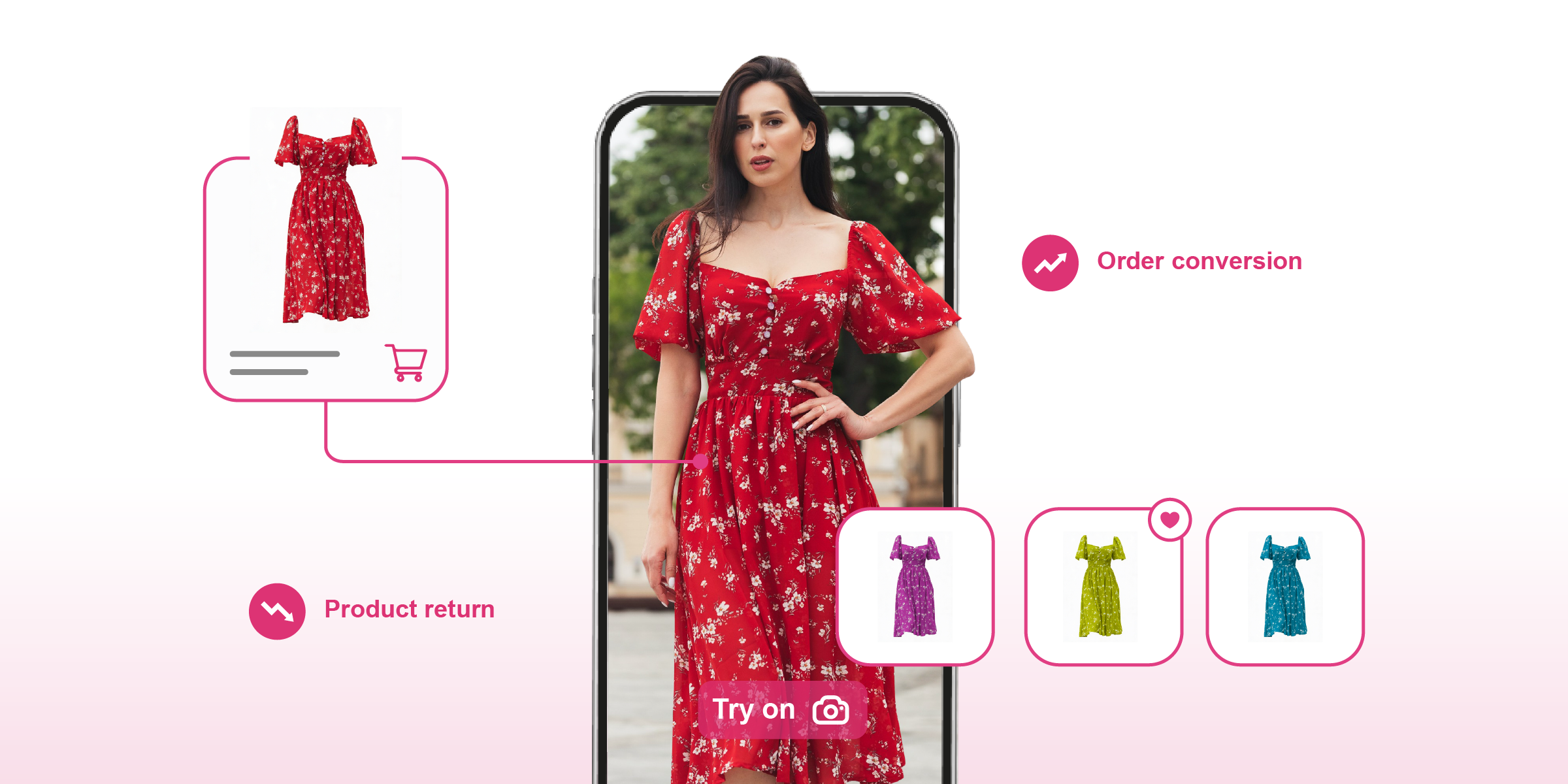
E-commerce has simplified the shopping process and made it quicker. However, it has also created an expensive dilemma on the part of the brands, as customers tend to purchase something without the complete knowledge of how this is going to appear, fit, and work in real life. Videos and pictures cannot convey everything, and once the expectations are not met in line with reality, this can translate into reluctance, carts dropped, and costly returns on products.
AR try-on is a solution that has quantifiable business effects. Industry research indicates that the global virtual try-on market is expected to expand to above USD 5.9 billion in 2025 ( reach up to USD 22. 1 billion USD in 2035), with a compound annual growth rate (CAGR) of 14.1 %. This development is commonly linked to increasing customer expectations of interactive and confidence-building shopping experiences to help them make better purchase choices.
Apart from enabling customers to see products in a more visualized manner, it serves as a revenue-generating tool to help companies realize actual ROI. According to the industry report of Shopify, it was said that the Gunner Kennels company integrated the AR technology and, as a result, experienced an increase of 40% in the order conversion rate for their business.
I also studied how a Brazilian cosmetics manufacturer and beauty retailer named Oceane embraced the AR try-on to market its products to customers. And in the long run, the company experienced an increase in the add to cart order rate, which moved from 3% to 20.15%. This can improve downstream conversion, depending on checkout friction and stock/price fact. This makes AR technology to serve as a good investment to rely on as a business owner.
In essence, AR is ceasing to be a nice-to-have feature for just displaying but a revenue-generating tool that will help companies to generate more revenue and customers’ engagement. So in this blog, I will be showing you how AR try-on is helping e-commerce to scale up and build a better platform for effective means of generating more revenue.
What is AR try-on in e-commerce?
AR try-on in online commerce means applying the use of augmented reality software that enables customers to have a digital preview of the products prior to making a purchase. The shopper is not restricted to just using a static image or video, but can view how a product would look on their own face, body, or physical surroundings through the use of a smartphone camera, web camera, or uploaded image. This provides a more realistic and interactive shopping process that is closer to in-store product testing.
Technically, AR try-on is a combination of AR, computer vision, AI, and 2D or 3D rendering. The major landmarks distinguished in the system are facial features, body contours, hands, feet, or room surfaces. These landmarks are then identified, after which the digital product will be anchored and tracked in real time.
This is to say that the overlay reacts naturally to the movement of the user. As an illustration, lipstick will not be painted off on the lips as the person continues to speak, eyewear will not move when the head turns, and furniture is designed to be displayed as the camera pans through a room.
This is the degree of realism that makes AR try-on more interactive than traditional photos/videos. Customers, instead of visualizing the appearance of a product, can view it in the real world and in different positions. Lots of AR try-on solutions can be used to change variants, including shades, colors, sizes, or styles, within a few seconds. This aids the shoppers to make comparisons with ease and choose the most appropriate alternative before making payments.
AR try-on is very useful in industries that are appearance-driven. In beauty and cosmetics, it assists the customers in sampling makeup colors and combinations. In apparel and eyewear, it enables customers to evaluate the size and design. It aids the styling and guidance of visual size in the fashion and footwear industries. It is applied in furniture and home decor, where the customer can visualize how a product can fit in their real space.
Therefore, AR try-on reduces uncertainty, which is one of the most significant problems of e-commerce, namely the lack of product certainty. Customers have a better idea of what they are purchasing, and they are therefore more assured about their choices. This can improve engagement and reduce returns based on meeting expectations. Simply put, AR try-on makes the process of online shopping more of an informed choice than guesswork.
{{component="/internal/widgets"}}
Key features of AR try-on

An AR try-on has to be effective in that the combination of accuracy, realism, performance, and smooth integration should support the confident buying process.
1. Precise monitoring and synchronization
Any successful AR try-on experience is based on accurate tracking. An appropriate AR try-on solution has to be capable of accurately tracking facial features, body motions, hands, feet, or surfaces in the room, based on the type of product. This tracking is to make sure that the digital product is always in position, as the user moves about.
Eyewear, as an example, should be in alignment with the eyes as the head turns, and lipstick on the lips as one speaks, and furniture as the camera pans. Without proper tracking, drifting, jittering, and misalignment may occur, and in no time, customers will lose trust and consequently cause more reluctance than otherwise. To be credible and make decisions with a high degree of certainty, the tracking should be stable and accurate.
2. True-to-life imagery and appearance
Realism is essential in customer perception, other than tracking. The quality AR try-on solutions rely on advanced rendering, which can be used to create the effect of lighting, shadows, textures, and material finishes. This aids in making the products seem organic and appropriate to the surrounding or skin colors of the user, as opposed to flat and artificial overlays.
In the case of beauty products, it is necessary to have real-world shade rendering and tone adjustments. In the case of fashion and furniture, the proportions and depth interpretation are important. If the products appear as real as possible, it can increase your customers' confidence in making a purchase.
3. Comparison and variant switching
A good AR try-on must enable the customer to change the variants of a product quickly. This is the ability to experiment with varying colors, shades, sizes, styles, or settings without having to reset the experience. Fast version comparison is easy to use as it does not waste time and allows shoppers to find alternatives to a product quickly, and can help to reduce the chances of making the wrong version.
AR try-on helps to make better decisions and can reduce the amount of post-purchase regrets, which directly leads to the decreased number of returns, by enabling side-by-side or sequential comparison.
4. Fluid business continuity
AR try-on should be a part of an e-commerce process. The experience must be integrated into a product page, a landing page, or a campaign flow without making users download other applications and abandoning a shopping experience.
Combination with add-to-cart and checkout secures that your customer can proceed without any hindrance in the event he/she is convinced. A lost or confusing system breaks the purchasing procedure and diminishes the conversion chances.
5. Informational analytics and performance
An appropriate AR try-on system should provide give actionable analytics. Measures like try-on utilization, duration of interaction, variants to add to cart, and conversion influence assist the brands in knowing how their customers behave.
Such insights enable businesses to manage product offerings, enhance merchandising, advance marketing campaigns, and improve ROI. In the long term, the optimisation on the basis of data guarantees that AR try-on is not static but performance-based.
How to select a suitable AR try-on for business purposes
The choice of the appropriate AR try-on solution is a tactical move that is directly related to customer experience, conversion rates, and ROI. The AR try-ons are not all created equally, and the incorrect selection of a tool can result in its low performance, loss of usage, and even higher returns. The use of AR try-on should be considered by businesses according to their needs and long-term perspectives.
1. What does your business stand for
To start with, companies have to select an AR try-on solution that fits their product line. Various products need varying tracking technologies. Beauty and cosmetics are extremely dependent on the ability to detect facial landmarks and the ability to render colors correctly. Eyewear and accessories would require good face and head tracking to be properly aligned.
While body part segmentation or size guidance could be necessary for fashion and footwear, spatial tracking and correct scaling are necessary for furniture and home furnishings. So it is important that the kind of AR try-on tool to select should be optimized for your type of product or services.
2. Realism ability
Second, realism must be one of the priorities. One of the most important factors that makes an AR try-on valuable is accuracy. In case products look distorted, lit wrong, or unrealistic, the customers will lose confidence in a short time.
GlamAR's AR try-on focuses on advanced rendering techniques so that the lighting, textures, proportions, and skin tones can resemble the real world as closely as possible. The realism can have a direct impact on the purchase confidence and lower the disappointment caused by the purchase.
3. Compatibility
Integration compatibility is critical for business efficiency. The AR try-on must also be connected with the existing e-commerce systems like Shopify, WooCommerce, Magento, or custom stacks.
An effective solution would also have flexible SDKs or APIs, which are easily embeddable into product pages, campaigns, and mobile experiences. Fragile or complex integrations add to the cost of development and slow down the deployment.
4. Friendly user experience
Fourth, performance and user experience should be taken into consideration. Any customer can use the AR try-on with a single touch, without spending time loading, and with no confusing user interface.
The interface should be fast, simple, and easy to use, which will lead to a higher rate of adoption and help customers spend more time exploring products. Sluggish performance, lack of speed, or crashes may annoy the users and decrease the conversion.
5. Scalability, analytics, and data privacy options
Lastly, scalability, analytics, and data privacy are to be considered by businesses. The AR try-on solution should support the expansion of product lines, increased traffic, and multiregional use without affecting performance.
The analytics are embedded within a business to provide a metric of engagement, variant popularity, and the impact of conversion. Simultaneously, to ensure that customers are not leaving, data protection laws like GDPR and CCPA require compliance to be implemented to reduce legal and compliance risk.
How AR try-on is boosting e-commerce sales
AR try-on is increasing commerce figures in the online platform since it can help to reduce a key source of uncertainty that contributes to abandoned purchases. In cases where shoppers are unable to check the fit, shade, scale, or style, they put off purchasing, leave carts, or place orders to see how it works and return later. AR try-on helps to flip that behavior; hence, it can help to boost sales. Let's talk more about this.
1. Improved conversion rate
The initial sales lever will be conversion lift. Several industry overviews indicate that retailers experience significant conversion growth once virtual try-on experiences are added, with the primary reason being the fact that customers are more confident in their purchasing decisions.
Indicatively, a research summary conducted by Focal retailer reported claims of up to 30% uplift in some virtual try-on scenarios. Interactive 3D experiences also seem to be associated with high performance in the ecosystem of Shopify. According to Shopify, merchants utilizing 3D commerce can see an average conversion rise of 94%.
2. Visualize product variants
In some implementations, AR try-on correlates with a higher average order value (AOV). AR try-on may encourage exploration of variants and complementary items. According to Banuba’s interpretation of industry trends and cited data, AR experiences have the potential to drive a 33% increase in AOV in some cases, which is typically fueled by cross-sells and upsells during the exploration phase.
3. Lower product return
The third lever is profit protection by lower returns. Revenue is erased by returns, making unsaleable goods, returns restocking, and loss of margin. Some reports and vendor case studies (e.g., Banuba) show return rate reduction of up to 64% in specific implementations, which can help improve profitability and paid marketing efficiency.

Benefits of the AR try-on for e-commerce
AR try-on can help increase sales, strengthen brand credibility, enhance the shopping experience, and reduce purchase uncertainty.
1. Improved conversion rates
Perhaps the most immediate advantage of AR try-on is the effect it has on the conversion rates. The online shoppers can be uncertain about making purchases because they cannot be able to have a total picture of how a product will appear or fit in the real world.
AR try-ons help reduce this ambiguity by letting customers see products on their faces or in their spaces. When consumers are confident, they are more likely to complete purchases instead of dropping their carts.
2. Lower rates of product turnover
One of the most costly issues in online retailing is returns. AR try-ons assist the customer in making better decisions during the checkout process, particularly in product lines like fashion, beauty, eyewear, and furniture.
It can help reduce returns due to incorrect size, shade, or looks by matching the expectations with reality. Several industry case studies report meaningful reductions in return rates with AR try-on and visualization tools, which have helped to achieve significant decreases in return rates, safeguarding revenue and enhancing margins.
3. Higher customer engagement
AR try-ons are inherently more engaging, as they make people perceive the items more realistically. Customers use more time to be able to explore variants, compare options, and experiment with styles. This time spent on the page is often accompanied by higher add-to-cart rates and better average order value.
4. Greater brand perception and trust
AR try-on experiences can position brands as innovative and customer-focused. Trust can increase when customers are given realistic previews during the try-on experience. This can continue to repeat purchases, positive reviews, and loyalty. AR try-on provides the brands with the opportunity to likely change the selling concept of the transactional model to experience-based trade.
5. Practical customer intelligence
AR try-on is also a source of useful behavioral data. Brands are able to study which products are most tried and which variants are performing, and where customers are hesitant and converting. The knowledge can help inform decisions around the maximization of product offerings, inventory planning, and marketing strategies, and make AR try-on a conversion tool and a data asset.
Leveraging GlamAR’s AR try-on
The AR try-on by GlamAR is positioned as an effective tool in the e-commerce space to make products more visually appealing to potential customers. The tool tends to create an interactive nature, which will help reduce guesswork and improve confidence in the buying decision process. Below are the reasons why you should leverage GlamAR's AR try-on:
1. Multi-category enablement
A broad multi-category support is one of the most important strengths of GlamAR. It is possible to have brands that allow trying on makeup, eyewear, accessories, jewelry, and even nails and hairstyles, all on the same platform. This is why GlamAR is appropriate in beauty, fashion, and lifestyle retailers who would like to provide an engaging shopping experience on their list.
2. Real-time AR rendering
One of the greatest advantages of GlamAR is that it has real-time AR tracking and rendering. The GlamAR AR engine is designed to maintain the digital product in the correct position as the user moves when they try on products such as glasses, jewelry, or lip color. Such realistic behavior approximates the physical experience of trying on and makes the experience natural and interesting.
3. Web-based solution
The solution by GlamAR is also web-based and, therefore, will not need a separate application to be downloaded. The virtual try-on can be initiated in real time, both in the supported browsers and mobile devices, which can reduce friction and improve usage. This helps to create a greater interaction for your customers without the need to have an extra app.
4. High-quality 3D models
One more significant characteristic is a 3D image of the products. GlamAR can support high-fidelity 3D models, which gives customers the opportunity to see products in all directions, details up close, and size and shape better. In products where the size and the visual presentation are critical, like eyewear or jewelry, this kind of detail can improve customers’ confidence.
5. Integration flexibility
GlamAR also has integration flexibility. SDKs or basic code snippets can integrate the platform into existing e-commerce to enable brands to integrate the AR try-on into the product pages, landing pages, or campaign experiences. This implies that AR does not present itself as an unrelated feature, but it can become an integral aspect of the shopping experience.
6. Analytics dashboard
Another feature of GlamAR includes analytics capabilities, which enable the brands to see how customers use the try-on experiences. Measures like the most viewed items and time spent allow retailers to make practical improvements to the merchandising and product approaches.
{{component="/internal/widgets"}}
Future of AR try-on for e-commerce
E-commerce has grown at a rather fast pace in the previous decade, yet one of the next major innovation areas lies in the area of immersive and interactive shopping. Which was initially a new feature, augmented reality (AR) try-on is currently heading towards becoming an expected capability in some categories, with the potential to transform the process of product evaluation and decision-making among consumers.
Brands that are looking into the future already are experimenting with more powerful AR features that will result in more interactions, more conversions, and increased loyalty.
1. Hyper-realism and photorealistic rendering
Improved realism is one of the largest future trends of AR try-on. The further development of 3D rendering, lighting modeling, camera-based tracking and motion modeling should lead to visuals closer to real-world appearance. It will ensure that the user can see products designed to react more naturally, move, reflect light, and react to their surroundings, which can increase their trust in online shopping.
Industry research suggests that immersive, interactive experiences are changing how customers perceive products, and they are minimizing the doubt in their buying decisions.
2. AI-powered personalization
The future of AR try-on will involve artificial intelligence to a greater extent. AI can customize the recommendations according to the behavior of the users, measurements, or their previous choices, and allow your customers to find the products that are uniquely adapted to them.
Emerging research and early implementation suggest that combining generative AI and computer vision will enable the fashion items and other accessories to change their shape, style, and proportions according to the body shape, style, and proportions in real-time.
This high-end personalization is not only more efficient in terms of satisfying the try-on experience but also helps improve conversion and reduce returns, as it matches the products to each person's shopping experience better.
3. Mobile-first and approachable AR experiences
Mobile products will remain the most prominent in the AR try-on. The mobile-first experiences, which do not necessarily require the need to download an app. It can be opened directly in a browser, expanding access and adoption as noted in reports about AR commerce trends.
This is in line with the expectations of tech-savvy consumers, particularly among Gen Z and younger millennials, who desire immediate and smooth communication with brands.
4. Omnichannel and cross-platform integration
The AR try-on systems of the future are expected to become more integrated at both the platform level, e-commerce websites, social media, marketplaces, and even in-store digital mirrors.
This omnichannel access will provide customers with the ability to enable scenarios such as a try-on in social media and check out in brand stores, or browse online and verify in stores. This helps reinforce integration, reinforces customer touchpoints, and establishes a unified shopping experience.
5. Personalization and insights through data
With the expanding AR try-on experiences, analytics on it will increase. Brands can gain better visibility into understanding the categories of products that are most tried, styles that best convert, and areas where shoppers hesitate.
These will enhance decision-making, inventory planning, and marketing strategies, and AR is not only a frontend feature but also a business intelligence resource at the back end.
Conclusion
AR try-on is not on the experimental side of e-commerce anymore; it has moved beyond experimentation in many categories to bring quantifiable business value. AR try-on helps to increase purchase confidence and reduces uncertainty by enabling customers to view products in real time. Moreover, AR helps brands to deal with one of the largest problems of online retail, which can help reduce product returns caused by unmet expectations.
In addition to enhancing the conversion rate, AR try-on can enhance engagement, brand trust, and can support improvements in merchandising and marketing decisions. The use of AR in e-commerce is expected to continue growing as it becomes more realistic, available, and interconnected across different platforms.
In sum, AR try-on is becoming a strategic requirement and not an optional benefit for many brands and categories that are committed to enhancing efficiency, securing margins, and offering customers a better shopping experience.
AR try-ons are a type of augmented reality that enables a customer to digitally preview a product on themselves or their physical space before making a purchase. A customer is able to use a smartphone camera, webcam, or image uploaded to view how a product, e.g., makeup, eyewear, clothing, accessories, or furniture, view how a product would look or be positioned. This helps bridge the gap between online browsing and in-store product trials.
Majority of AR try-on companies can provide integration capabilities in form of SDKs, API, plugins, or embedded widgets. Businesses can enable customers to use AR try-on on product pages, landing pages, or even campaigns with the help of these tools. It is not uncommon to integrate into pre-existing e-commerce systems or custom technology stacks, which might implies a minimal disruption to the existing shopping flow.
AR try-on enhances the online shopping process by assisting customers in making better choices. It can builds confidence, reduces hesitation, improves conversion rates, and help lower returns because expectations are better aligned with reality.
Yes.The majority of AR try-on solutions can be integrated into most popular e-commerce platforms(Shopify, WooCommerce, and Magento) and even custom websites. Providers normally provide adaptable integration solutions to adapt to various technical configurations.
AR try-on is particularly useful in the case of companies that sell products in which appearance, fit, size, or style has a bearing on purchase.AR try-on can deliver strong ROI in scenarios where customers are frequently hesitant, leave carts, or send goods back because of unmet expectations.
AR try-on can improved ROI by increasing conversions and reducing returns which can help lower operational and logistics cost, helping to contribute to higher consumer satisfaction, and lifetime customer value. In the long run, it assists brands to work more effectively and contribute to the sustainable increase in revenues.
Discover how AR, VR and 3D can drive revenue growth in 2025
Schedule a call with our team